
Quick answer
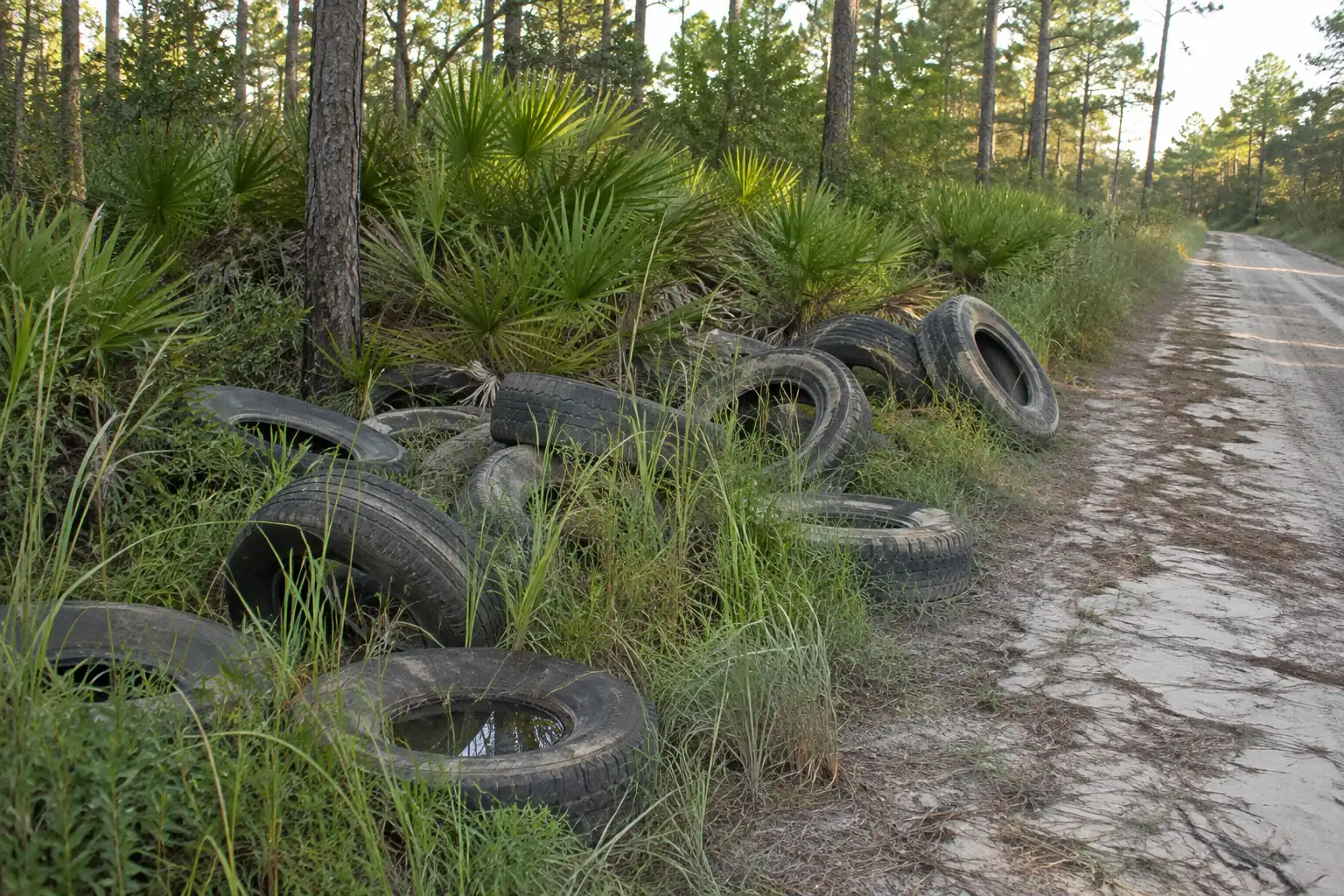
Tires hold rainwater, and the U.S. EPA notes that mosquitoes can breed in the stagnant water that collects inside them; Florida’s health department lists old tires among the things to discard to stop mosquitoes. Tire fires are difficult to extinguish, can burn for a long time and release thick black smoke, so a tire pile should go to a permitted facility, not sit outside.
Why tires breed mosquitoes
A tire is shaped to hold water. Rain runs inside the casing, sits there out of the sun, and stays warm. The U.S. EPA’s page on scrap tires puts it plainly: mosquitoes can breed in the stagnant water that collects inside tires, and several kinds of mosquitoes carry disease.
Florida’s Department of Health runs its “Drain and Cover” campaign on the same idea. Its prevention advice tells residents to drain standing water and to get rid of old tires, drums, bottles, cans and other unused items that collect it. Orange County’s tire page warns the same thing: tire piles can be breeding grounds for mosquitoes.
In a Florida summer a single tire full of rainwater is enough. A pile of a hundred is a problem for the whole street.
Why tire fires are so bad
Tires are made to last, and that is exactly the trouble when they burn. According to the U.S. EPA, scrap tire fires are difficult to extinguish and can burn for long periods. They release thick black smoke and can contaminate the soil with an oily residue.
That is why no one should ever burn tires to get rid of them, and why a big pile near a building, a fence line or dry brush is a real risk. A tire pile doesn’t need to be huge to cause a serious fire.
What the law says about dumped tires
Florida’s Litter Law (Statute 403.413) names tires in its definition of litter. The penalty depends on the amount:
- Up to 15 pounds or 27 cubic feet, not for commercial purposes: a noncriminal infraction with a $150 civil penalty.
- Over that, up to 500 pounds or 100 cubic feet: a first-degree misdemeanor.
- Over 500 pounds or 100 cubic feet, or any amount dumped for commercial purposes: a third-degree felony.
One passenger tire weighs more than most people think, so a handful of tires gets past the first line fast. On top of that, whole waste tires are banned from Florida landfills (Statute 403.717). The full picture, including the 25-tire records rule for businesses, is in is it illegal to dump tires in Florida?
Keeping tires safe until they leave
Sometimes tires have to wait a few days — a shop between pickups, a landlord cleaning out a unit, a family finishing a project. If they must sit, keep the time short and the setup simple:
- Keep them dry. Store them under a roof or tarp, or stand them so water can’t sit inside the casing.
- Tip out any water after every rain. Draining standing water is the first step of Florida’s “Drain and Cover” advice.
- Keep them away from buildings, fences, dry brush and anything that can spark.
- Keep the count small. If the stack keeps growing, that is the sign you need a pickup schedule, not more space.
If you find tires dumped on your property
- Don’t burn them or bury them. Both make the problem worse.
- Tip the water out and keep them dry until they’re gone, so they stop breeding mosquitoes.
- Take photos and report illegal dumping to your city or county code enforcement.
- Get them to a permitted facility. Bring them to our Apopka counter at $3 a tire, or for a big pile send us a photo on WhatsApp and we’ll quote the haul.
For shops and property owners: stop the pile before it starts
Most dangerous piles start the same way: a shop that changes tires every day and has no rhythm for getting the old ones out. Scheduled pickup fixes that. We come out on a set schedule across Orange and Seminole County, haul them to a permitted facility, and you keep the records Florida expects once you pass 25 tires a month. See scrap tire pickup for shops, dealers and fleets.

Questions people ask
Why do tires breed mosquitoes?
Tires hold rainwater that sits warm and shaded inside the casing. The U.S. EPA notes mosquitoes can breed in that stagnant water, and Florida’s health department lists old tires among the items to discard.
Why are tire fires hard to put out?
The U.S. EPA says scrap tire fires are difficult to extinguish, can burn for long periods, release thick black smoke and can leave an oily residue in the soil.
What is the fine for dumping tires in Florida?
Under the Florida Litter Law, up to 15 pounds is a $150 civil penalty; up to 500 pounds is a first-degree misdemeanor; more than that, or any amount for commercial purposes, is a third-degree felony.
Someone dumped tires on my land. What do I do?
Don’t burn or bury them. Empty the water, take photos, report it to code enforcement, and get them to a permitted facility — $3 a tire at our Apopka counter.
Sources
- U.S. EPA (archive) — Scrap tires: health and environmental concerns
- Florida Department of Health — Mosquito-borne disease prevention ("Drain and Cover")
- Orange County — Tire Disposal
- Florida Statute 403.413 — Florida Litter Law
- Florida Statute 403.717 — Waste tire and lead-acid battery requirements
Official pages read 2026-11-21.

Ruben Feliz
Owner and licensed operator of Feliz Family Recycling LLC in Apopka (WACS #108814). The Feliz family has worked with tires in Central Florida since 1994; Ruben reviews every guide on this site.